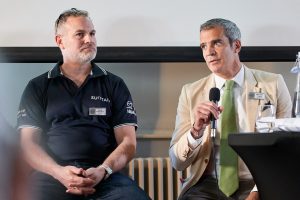
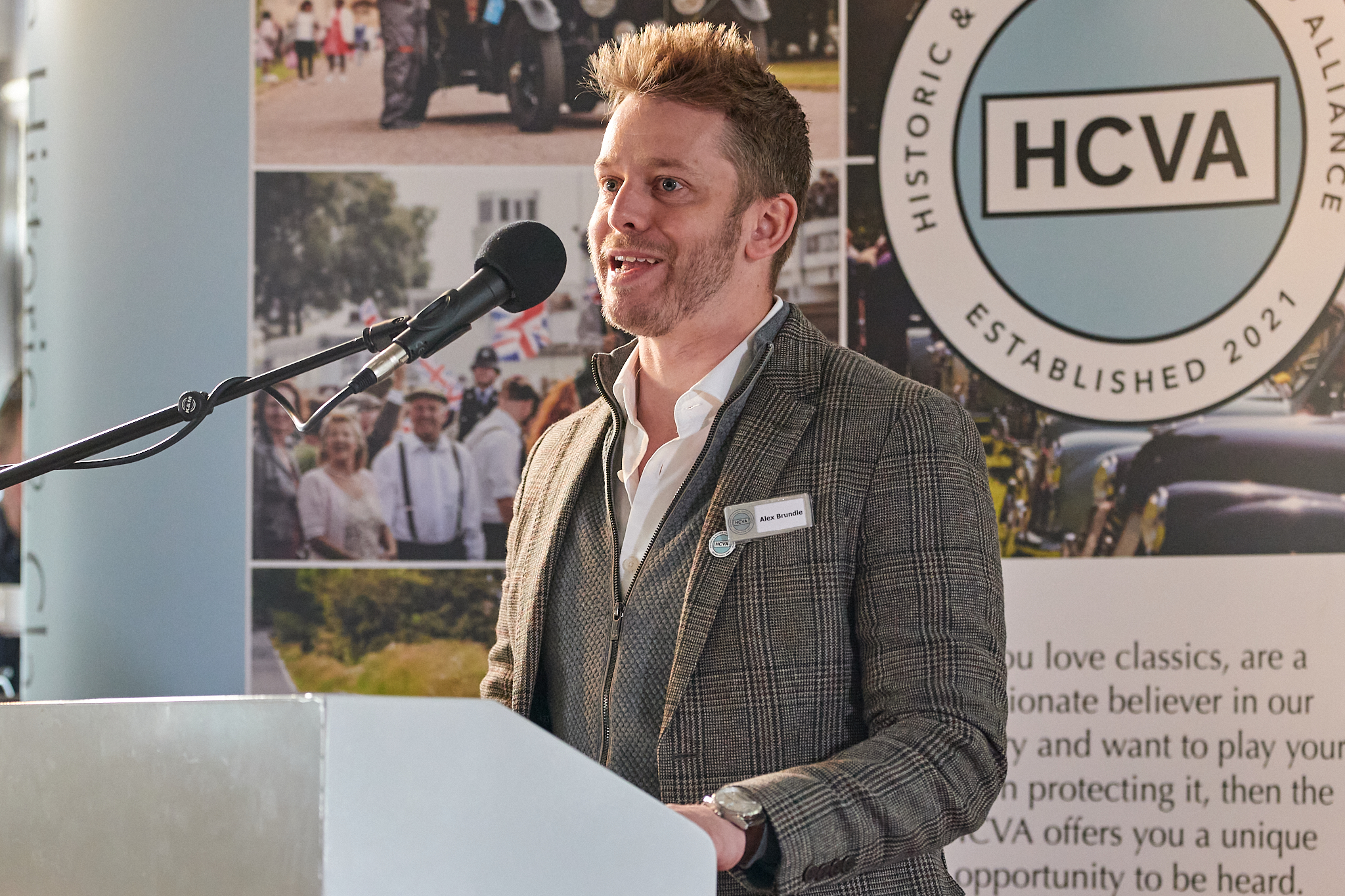
The HCVA (Historic and Classic Vehicle Alliance) held its sixth industry conference at Brooklands Museum and highlighted a number of key challenges facing the classic car world. Among the main talking points were the need to address fuel security for older vehicles, succession planning for businesses, and how companies can adapt to changing demands and tastes.
Guest speaker and racing driver Alex Brundle pointed out the need to divert young people’s attention away from ‘toxic social media’ and get them enaged in hands-on experiences, such as with classic cars. He said: ‘Millennials are struggling with a crisis of ownership: their car is leased, their music is streamed, they live their life on a subscription model. Social media is intolerant and jealous, but is the only piece of real estate that they own. So businesses need to answer that content creator or intern, listen to what they want and help them onto the first rung on the ladder – the young people need you and we need young people in our industry. Classic cars to save the world seems a slightly grandiose statement, but they might save someone and that’s enough isn’t it?’
The following discussion around sustainable fuel was especially pertinent given the current high cost of fuel and showed the classic sector has an opportunity to lead the entire automotive industry. James Hannon, of the HCVA’s Sustainable Liquid Fuels Working Group, led the talk and posed questions around affordability, availability and legislation.
David Richardson, from fuel producer Sustain, said: ‘Legislators in the UK are aware of sustainable fuel, but whether they care about it is another matter.’
Dr Mark Dibben, who has advised the Vintage Sports-Car Club on this topic, added: ‘The UK government is focused on tailpipe emissions to improve air quality rather than for purely environmental reasons, whereas other European countries are using sustainable fuel, and EV adoption, as holistic approach to the problem.’
Also contributing to this discussion was Dario Galli-Zugaro of Hero-ERA, who said: ‘There is no ideological barrier or mechanical reason not to use sustainable fuel. Often, a car runs better on this type of fuel, so this is a marketing issue to some extent as sustainable fuel is seen as too expensive and until we have a critical mass of drivers using it, that will be a hurdle.’
Chris Chance, of FU3L, commented: ‘We could move to a fully sustainable fuel model, but we need to ramp up production now to achieve this by 2040 in the UK.’
While the future of sustainable fuel remains up for debate, the question of succession planning garnered more positive and some unexpected answers. Georgina Wood, of Rolls-Royce and Bentley specialist P&A Wood, noted: ‘We are happy with slow change as a business as we can see how others are doing things and learn from that. We have seen a shift in how we promote ourselves, especially through social media, and there is a difference in customers: the traditional type who keeps a car for a very long time versus the newer generation who want to experience a car and then move on to the next.’
Wood also noted the difficulty in finding skilled young staff, but also believed this was an improving situation as more school leavers become aware of the classic sector as a career path. Mike Harding, of Harding Auto Services, agreed with this and said: ‘Transferable skills between old and new tech, such as fuel injection on newer classics, means apprentices are in a great place to work on a huge array of vehicles. When we reverse engineer a part for a car, we don’t leave in the flaws that made it fail in the first place, we have the opportunity to improve and adapt. This is how we help apprentices think.’
During this section of the conference, James Mitchell, of Curated by Pendine, also took the chance to embrace change that some might see as negative effects on the industry. He said: ‘The shift in values of classic cars, which has seen most devalue in the past year or two, is not the problem many perceive it to be. My view is it’s an opportunity for younger, less affluent buyers to enter the market and enjoy the car of their dreams. The more accessible and available cars are to a wider audience, the better it is for the whole sector.’
Turning the focus back to apprentices, Steve Cootes, General Manager of charity StarterMotor, said: ‘My challenge begin earlier than this as most schools don’t have the resources to get students into suitable work experience. What I find is when this happens, around 5% of kids have that interest and spark for heritage engineering and classic cars. I am always on the lookout for more companies to offer experience to students as this will help secure the future of the industry – without people to work in the cars, many owners simply won’t be able to use their classic.’
Given the classic car park in the UK is only set to expand as the DVLA, represented by Dudley Ashford, showed figures that 1 million cars from the 1990s will soon start to become eligible for classic tax-free status in the UK. This is on top of the current 600,000 classics already registered in the UK. The HCVA’s CEO Dale Keller concluded: ‘We have to adapt or die as an industry. The ownership and how we own classic cars is changing, and the industry has to play its role in this shared future.’
Images courtesy of Gun Hill Studios